

Trust
The Invisible Conversion Lever Most Copy Misses

VijayWrites #297
Welcome to VijayWrites, where you’ll find inspiration, tips, and ideas to help you write better, master the art of copywriting, and make a career out of your words.
They stopped. They felt the gap. They know what you’re offering.
But there’s still one question running through their mind:
“Why should I believe you?”
That’s what Trust answers.
What Trust Does
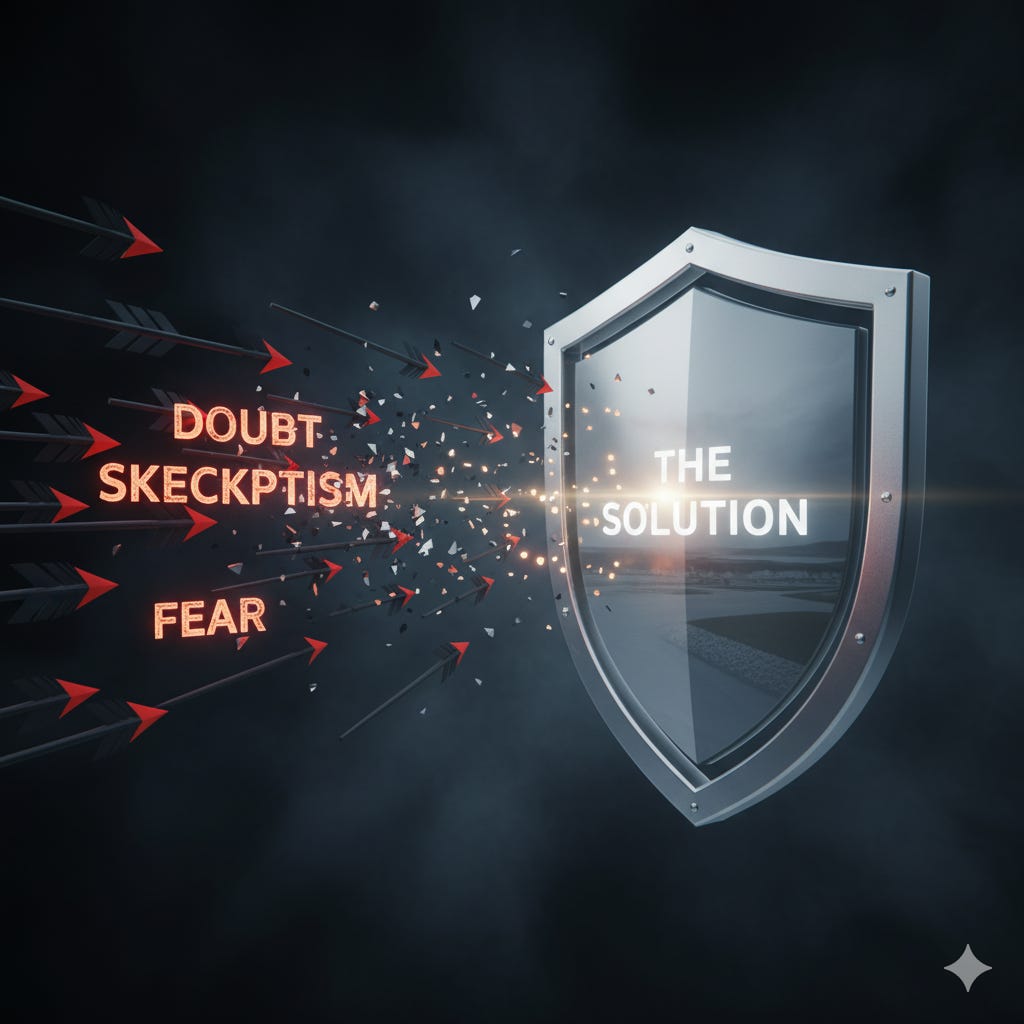
Trust’s job is to remove doubt by showing why your solution works.
You do this in two ways:
Proof – Evidence that it works (testimonials, results, case studies, credentials)
Mechanism – Explanation of how it works (the process, the logic, the reasoning)
You’re not trying to overwhelm them with every piece of proof you have. You’re strategically answering their skepticism.
Think of Trust as the moment you say: “I know you’re wondering if this will work for you. Here’s why it will.”
Why This Matters
Here’s the reality: Skepticism is the default.
Your reader has been burned before. They’ve tried things that didn’t work. They’ve been promised transformations that never came.
So even if everything you’ve said so far is perfect—even if they want what you’re offering—they’re still asking, “But will it work for me?”
Trust is what tips them from “I’m interested” to “I believe this.”
Without it, your copy might create desire but never convert.
Where People Make the Mistake
The biggest mistake? Dumping proof without context.
“Here are 47 testimonials.”
“Look at all these case studies.”
“I have 10 years of experience and 15 certifications.”
It’s not that proof is bad—it’s that irrelevant proof is noise.
Your Trust section should answer specific objections or doubts your reader has. Not just prove that you’re credible in general.
Compare these:
“I’ve been doing this for 10 years.”
vs.
“I’ve written copy that’s generated millions—using this exact Blueprint.”
“Here are 20 testimonials from happy clients.”
vs.
“This system worked for Sarah, who went from framework-hopping to launching her first six-figure campaign in 8 weeks.”
See the difference? One is generic credibility. The other answers a specific doubt.
Another mistake: Skipping the mechanism.
Sometimes your reader doesn’t just need to see that it works—they need to understand why it works.
“This course teaches you the Universal Copy Blueprint. You’ll learn the five elements, understand the psychology behind each one, and apply it across every format.”
That’s the mechanism. It gives them confidence that there’s a real system, not just hype.
Do This Now:
Look at your Trust section. Ask yourself:
What’s the biggest doubt my reader has right now?
Am I answering that doubt with relevant proof or a clear mechanism?
Or am I just listing credentials that don’t address their specific skepticism?
If you’re not sure what their doubt is, start there. Because if you don’t know what they’re skeptical about, you can’t remove it.
Next up: Element #5—Action.
They believe you. Now you need to make it easy for them to take the next step.
P.S. This is Element #4 of The Universal Copy Blueprint—the core framework I teach in CopyThinking. If you want to master this system and apply it across every format you write, stay tuned.